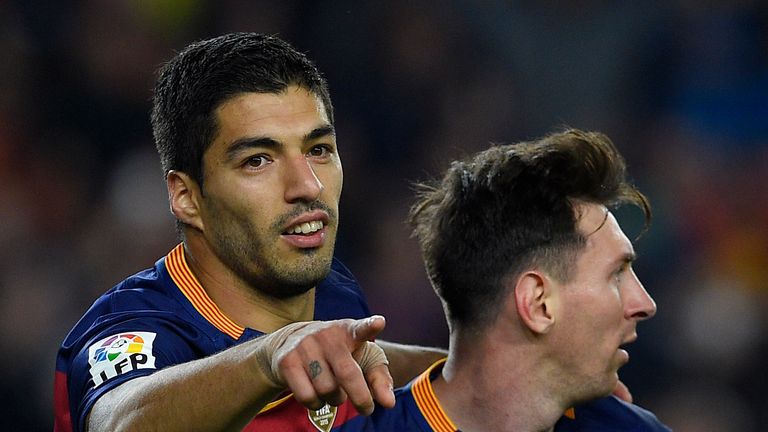
Luis Suarez believes Barcelona team-mate Lionel Messi will reconsider his decision to retire from international football.
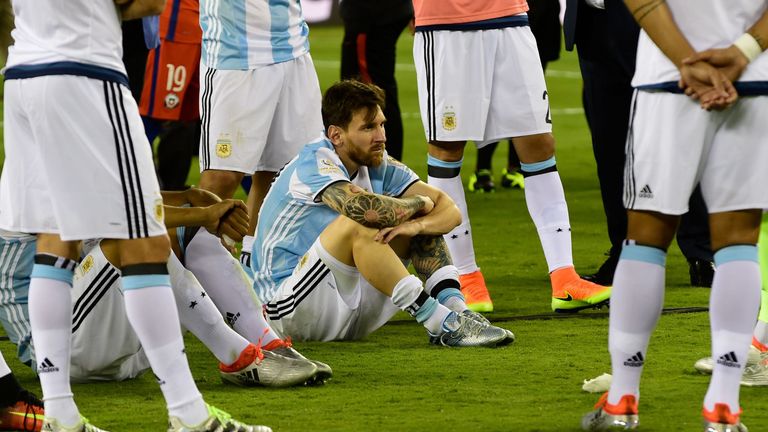
Messi called time on his Argentina career last month in the wake of their defeat to Chile in the Copa America final, where Messi was one of those to miss in the penalty shoot-out.
The revelation came as a major shock, with Messi still only 29, but Uruguay striker Suarez feels his fellow South American can still make a contribution to the international game.
International Champions Cup,Tomorrow, 23:30pm
Celtic v Leicester
PRICE BOOST
Leigh Griffiths to score first
PRICE BOOST
WAS9/2
NOW6/1
Celtic to win 2-0
PRICE BOOST
WAS16/1
NOW20/1
Leicester to win 3-1
PRICE BOOST
WAS16/1
NOW20/1
Speaking at press conference on Friday, Suarez said: "The truth is that I cannot imagine Leo not playing with Argentina.
"As a friend and a fan of football I'd like to see him continue with the national team.
Luis Suarez says he cannot imagine Messi will be able to resist Argentina's call
"His love for country is indisputable, but you also have to understand his reaction after losing the final. I think he'll reconsider."
Messi, who has won the FIFA Ballon d'Or five times, is Argentina's record goalscorer with 55 goals in 113 appearances but has failed to win a major trophy with his country despite reaching four finals.
Lionel Messi announced his retirement after Argentina's Copa America defeat
The defeat to Chile in the Copa America is the second final heartbreak Messi has had to deal with after Germany were crowned world champions at the expense of Argentina in 2014.
With the Argentina squad still in town following their 3-0 Copa America win over Bolivia, a few of the Seattle Seahawks were lucky enough to bump into some football royalty on Wednesday.
Indeed, Steven Hauschka and Jermaine Kearse came over ever so slightly star struck when they were able to grab a quick photo with Lionel Messi and Sergio Aguero at the NFL franchise's training complex.
The meeting was especially profound for Hauschka, who spent almost 20 years playing association football before making the jump to the American version.
For what it's worth, Aguero definitely seemed to enjoy himself too.
How nice.
Editor of Who Ate All The Pies (@waatpies), Chris has worked for Shortlist, Metro and a smattering of other football blogs.
What quality did Pele and Diego Maradona have that Lionel Messi lacks?
A disconsolate Lionel Messi walks past the Copa America trophy.
Lionel Messi has now been a senior international player for over a decade; his Argentina debut came against Hungary on August 17th 2005.
It is not an occasion that he can look back upon with a great deal of pleasure. Just turned 18, he was unleashed as a second half substitute. He was straight into the action, but after only two minutes he launched himself on one of those characteristic runs, ball tied to his left foot. An opponent held on to him, dragging him back. Messi fought to free himself and was absurdly sent off for throwing an elbow.
Dragging Messi back in recent times has been his lack of a senior international title. He could hardly have come closer, carrying Argentina to narrow defeat in last year’s World Cup final, and then losing out to Chile in a shoot out in the final of this year’s Copa America. 46 goals in 103 caps is a magnificent record, with 29 of them coming in the last 40 games, when he has been the captain. But the lack of silverware with his country is always brought up in every discussion about his place in the all time pantheon.
The great Tostao, Brazil’s 1970 World Cup centre forward, is in no doubt that his attacking partner Pele was the best ever. He concedes that Messi is better at setting up the play. But he believes that Messi “lacks the personal transformation, the fury that Pele and other superstars had in big games and in the greatest difficulties. Pele was like a cornered animal, uptight when he was unable to do what he liked and what he wanted. He would try other solutions.”
It is an interesting psychological analysis. Messi is clearly a quieter, less demonstrative figure than Pele or Diego Maradona. “He is not self-sufficient,” continues Tostao, “he does not have the absolute lack of modesty which [renowned Brazilian writer] Nelson Rodrigues used to say was Pele’s greatest quality.”
Messi, then, is a player for whom the collective context is all important. This, in essence, is Tostao’s argument. He cites a moment in the Copa America final, in the last minute of normal time, when Messi at last managed to turn and slip his markers before launching a run that took him to the edge of the area – where he slipped a pass to Ezequiel Lavezzi on the left. Lavezzi squared, but Gonzalo Higuain arrived at the far post a fraction of a second too late to steer the ball home. Tostao calls Messi’s choice of move “correct,” but says that “the other option, to try and complete the move on his own, is what he should have done. Messi plays with Argentina as he does for Barcelona,” he continues. “A virtue in his club side, choosing the moment to go for the solo move, is a defect with his country, because it makes him trust too much in the collective game.”
This is also fascinating, but perhaps a little unfair. It just so happened that at this moment his attacking partners were Lavvezzi and Higuain. Angel Di Maria had pulled up injured and Sergio Aguero had been substituted, almost certainly an error. But a collective context where Messi is partnered by a fit and firing Di Maria and Aguero is not radically different from the one he plays in every week for Barcelona.
There is, though, a substantial difference in the context of the team as a whole. Tostao may well argue that “Messi plays with Argentina as he does for Barcelona.” But however rich their attacking resources, it cannot be argued that Barcelona play as Argentina do. There are fundamental differences – the main one being in the positioning of the defensive line.
Barcelona, of course, are known for pressing to win the ball back as soon as they have lost it, with the back four playing high up the field. Argentina’s current crop of centre backs lack the pace to do anything similar, and so the line tends to drop much deeper. This obviously has implications on the way Messi plays. When Argentina win back possession they are often much further from goal than is the case with Barcelona. Messi has a much greater area of the pitch to cover – which surely helps explain the end of season burn out he seemed to be suffering during the World Cup and in the final of the Copa America.
After reaching the Copa América final, Lionel Messi was awarded a longer vacation than the rest of his Barcelona teammates. He deserved a good rest after being the star of a Treble-winning season, plus carrying Argentina on his back all the way to the South American Cup second place finish.
But every world-class athlete, regardless of the sport, takes care of his body even in the offseason. Messi is back home in Catalonia, and he's getting ready by himself to return to the Blaugrana club on Monday to start his preseason preparations with the team.
So Messi took to the treadmill. With Thiago, his son, in the most adorable video you will find on the internet today:
SANTIAGO, Chile -- One way or another, history will be made. Old taboos will fall, and with them, some long-held preconceptions.
Should Chile win the Copa America on Saturday, it would be the first time that they rise above the continental competition after 99 years and 37 attempts. On four occasions they finished as runners-up. As history would have it, the cruelest of those was 60 years ago. It came in this stadium against this opponent.
Back then, the Copa America was known as the South American championship and consisted of a round-robin group. The final match, then as now, pitted host Chile against Argentina. Both teams went in level on points. More than 65,000 fans filled the Estadio Nacional; many more were outside. A crush developed when the ticket offices opened late. Six supporters lost their lives, and a few dozen more were injured. The game went ahead on police advice, and Argentina, led by the legendary Angel Labruna, edged Chile 1-0.
Expectations are as high this time around as they were back then.
And should Argentina win the Copa America for the 15th time? Well, not only will they pull even with Uruguay as the nation that has won the most, but there also will be one fewer argument against Lionel Messi belonging among the greatest ever.
ESPN FC's Gab Marcotti is leaning slightly towards Chile in the Copa America final, but Tommy Smyth still believes Argentina are the clear favourites.
Until recently, the Barcelona striker has been dogged by the accusation that he performs better for the Catalans than for his own country. It's a tough argument to fathom when you consider that having just turned 28, he ranks second in all-time scoring for the Albiceleste (Gabriel Batistuta, 10 goals away, is within reach) and has the fifth-most caps (with 102; Javier Zanetti's 145 may or may not be unattainable, but he should at least retire in second place).
Still, the critics point to what separated him from the likes of Diego Maradona and Pelé: a lack of major silverware with his country. That, too, is surely crumbling given that Messi's Argentina took Germany to extra time in the World Cup final last summer. But if he delivers the Copa America on Saturday (and he's been outstanding in this tournament despite his lack of goals) he will have removed that burden from his shoulders as well.
That's the nature of international tournaments. You can prepare for them all you like, but so much has to do with what condition you're in when you get there.
Take Chile. Arturo Vidal had a slow start to the season at Juventus before finishing on a high. Alexis Sanchez had the reverse, and in some respects, he hasn't hit his usual heights in this tournament. Jorge Valdivia played a grand total of five competitive games for his club, Palmeiras, in 2015, which meant he arrived fresh and peaking at this Copa.
As for Messi, there was reason to believe that after a campaign in which he started 57 games for Barcelona and was substituted just once, he'd be somewhat battle-weary by the time he got to Chile. Not so; the array of lucid passes and sudden, streaky acceleration he displayed against Colombia and Paraguay suggest that he's as sharp now as he's been in a long time. That obviously wasn't the case at last summer's World Cup, where, after serving up that ludicrous assist for Angel Di Maria against Switzerland in the round of 16, he seemed to be present in body only.
The subtext involving the two managers, Gerardo "Tata" Martino and Jorge Sampaoli, is equally fascinating. They don't just share a nationality (both are Argentines); they are also united by the fact that they had to emigrate to find job opportunities.
Martino enjoyed a successful topflight career as a player and coached some minor clubs in Argentina, but he really found his feet only abroad. He won three league titles at Libertad and a fourth at Cerro Porteno, making him a hero in a less glamorous league and giving him a chance at international management with Paraguay. In six years at the helm, he took them to the quarterfinal of the 2010 World Cup and 2007 Copa America, as well as the final of the 2011 Copa America. That's what put him back on the map, allowing him to get major club gigs at Newell's Old Boys and then Barcelona before taking the Argentina job.
Sampaoli's route was even more circuitous. He played his youth football for Newell's around the same time as Martino, two years his junior. A double leg break ended his dreams of professional football at age 19, and he devoted himself to coaching. He didn't just start at the bottom of the pyramid; he was in the basement.
He took charge of a variety of youth and amateur sides, one of the dozens of faceless young coaches who hope to make a name for themselves. Yet the call never came, so he emigrated, leaving Argentina in 2002 and having spells in Peru, Ecuador and Chile, winning plaudits for his aggressive, high-energy style more than his results.
Eventually, Sampaoli landed at Universidad de Chile in December 2010, and even that was because Diego Simeone pulled out of the job at the last minute. The rest is history. Sampaoli's version of "La U" dominated the league and won the Copa Sudamericana. He moved up to the national side and drew rave reviews at the World Cup, beating Spain in the group stage and losing to Brazil only on penalty kicks after nearly knocking out the hosts when Mauricio Pinilla's finish crashed against the woodwork.
In other words, these are two coaches who came up the hard way. Nothing came easily for them, and it's the sort of origin story that engenders respect from the playing squad.
Both men have applied important tweaks to their national sides in this tournament. Messi is neither a striker nor a false nine under Martino. He's a real 10, as he showed against Peru with devastating consequences. Why mess with a successful formula? Because Martino understood that what works at Barca won't necessarily work with Argentina. Sergio Aguero isn't Luis Suarez, Angel Di Maria isn't Neymar and Javier Pastore certainly isn't Andres Iniesta. This set-up, with Messi coming inside to support and interchange with Pastore, has benefited both the creation in midfield and the movement up front.
Sampaoli has also evolved. What was once a Marcelo Bielsa-esque, all-over-the-pitch press in his "La U" days is now somewhat more studied. It has to be when you're carrying a guy like Valdivia in the hole: His moments of magic are worth having every day of the week, but equally, you can't ask him to run himself into the ground. The back four, as opposed to the futuristic 3-3-1-3 scheme of "La U," is also a nod to greater pragmatism aimed at ensuring his better players get into the side: When you coach a nation, you don't have the luxury of buying players who fit your scheme.
It's enough to make you wonder whether either man will spring a surprise in the final. Will Sampaoli be tempted to conjure up something special to counter the times that Messi and Pastore team up inside? Will Martino revisit the build-up from the back given Chile's high press?
Whatever the case, we will see history made on Saturday. And we'll enjoy the privilege of seeing one of the greatest footballers ever in full pomp and one of the most innovative coaches in the world game trying to stop him.