"Messi" redirects here. For the biopic, see Messi (film).
This name uses Spanish naming customs: the first or paternal family name is Messi and the second or maternal family name is Cuccittini.
Lionel Messi

Messi playing for Argentina in the 2014 FIFA World Cup Final
|
| Personal information |
|---|
| Full name | Lionel Andrés Messi Cuccittini[1] |
|---|
| Date of birth | 24 June 1987 (age 28) |
|---|
| Place of birth | Rosario, Argentina |
|---|
| Height | 1.70 m (5 ft 7 in)[2] |
|---|
| Playing position | Forward |
|---|
| Club information |
|---|
Current team
| Barcelona |
|---|
| Number | 10 |
|---|
| Youth career |
|---|
| 1995–2000 | Newell's Old Boys |
|---|
| 2000–2003 | Barcelona |
|---|
| Senior career* |
|---|
| Years | Team | Apps† | (Gls)† |
|---|
| 2003–2004 | Barcelona C | 10 | (5) |
|---|
| 2004–2005 | Barcelona B | 22 | (6) |
|---|
| 2004– | Barcelona | 315 | (286) |
|---|
| National team‡ |
|---|
| 2004–2005 | Argentina U20 | 18 | (14) |
|---|
| 2007–2008 | Argentina U23 | 5 | (2) |
|---|
| 2005– | Argentina | 103 | (46) |
|---|
|
|
|---|
* Senior club appearances and goals counted for the domestic league only and correct as of 23 May 2015.
† Appearances (Goals).
‡ National team caps and goals correct as of 4 July 2015 |
Lionel Andrés "Leo" Messi Cuccittini (Spanish pronunciation: [ljoˈnel anˈdɾes ˈmesi] ( listen); born 24 June 1987) is an Argentine professional footballer who plays for Spanish club Barcelona and the Argentina national team. He is a forward and serves as captainfor Argentina.
By the age of 21, Messi had received Ballon d'Or and FIFA World Player of the Year nominations. The following year, in 2009, he won his first Ballon d'Or and FIFA World Player of the Year awards. He followed this up by winning the inaugural FIFA Ballon d'Or in2010, and then again in 2011 and 2012. He also won the 2010–11 UEFA Best Player in Europe Award. At the age of 24, Messi became Barcelona's all-time top scorer in all official club competitions. In September 2014 he scored his 400th senior career goal for club and country aged just 27. In November 2014, Messi became the all-time top scorer in La Liga, and the all-time leading goalscorer in the UEFA Champions League.
Often considered the best player in the world and rated by some in the sport as the greatest of all time,[3][4][5][6][7][8] Messi is the first football player in history to win four FIFA/Ballons d'Or, all of which he won consecutively, and the first to win three European Golden Shoe awards. With Barcelona, Messi has won seven La Ligas, three Copas del Rey, six Supercopas de España, four UEFA Champions Leagues, two UEFA Super Cups and two FIFA Club World Cups.
Messi is the only player to top-score in four consecutive Champions League seasons, and also holds the record for the most hat-tricks scored in the competition with five. In March 2012, he made Champions League history by becoming the first player to score five goals in one match. In the 2011–12 season, Messi set the European record for most goals scored in a season with 73 goals, set the goalscoring record in a single La Liga season with 50 goals, and became the second player ever to score in six different official competitions in one season after Pedro.[9] In February 2013 he scored his 300th Barcelona goal. On 30 March 2013, Messi scored in his 19th consecutive La Liga game, becoming the first footballer in history to net in consecutive matches against every team in a professional football league. He extended his record scoring streak to 21 consecutive league matches. In March 2014, with a hat-trick against Real Madrid, Messi became the player with the most goals and most hat-tricks in the history of El Clásico. In October 2014, Messi, aged 27, became the youngest player to score 250 goals in La Liga. In November 2014, Messi scored a hat-trickagainst Sevilla to reach 253 La Liga goals, becoming the all-time top scorer in La Liga. In May 2015, he scored his 77th Champions League goal to become its all-time leading scorer.
Messi helped Argentina win the 2005 FIFA U-20 World Cup, finishing as both the best player and the top scorer (with six goals). In2006, he became the youngest Argentine to play and score in the FIFA World Cup, and won a runners-up medal at the Copa América in 2007, in which he was named young player of the tournament. In 2008, he won an Olympic Gold Medal with theArgentina Olympic football team. At the 2014 World Cup, he led Argentina to the final, winning four consecutive Man of the Match awards in the process, and received the Golden Ball award as the best player of the tournament. In 2013, SportsPro rated him the second-most marketable athlete in the world.[10] In 2015, he won a second runners-up medal at the Copa América. His playing style and stature have drawn comparisons to compatriot Diego Maradona, who himself declared Messi his "successor".[11]
Contents
[hide]
- 1 Early life
- 2 Barcelona
- 2.1 2000–05 junior years
- 2.2 2005–06 season
- 2.3 2006–07 season
- 2.4 2007–08 season
- 2.5 2008–09 season
- 2.6 2009–10 season
- 2.7 2010–11 season
- 2.8 2011–12 season
- 2.9 2012–13 season
- 2.10 2013–14 season
- 2.11 2014–15 season
- 3 International career
- 3.1 2006 World Cup
- 3.2 2007 Copa América
- 3.3 2008 Summer Olympics
- 3.4 2010 World Cup qualification
- 3.5 2010 World Cup
- 3.6 2011 Copa América
- 3.7 2014 World Cup qualification
- 3.8 2014 World Cup
- 3.9 2015 Copa América
- 4 Style of play
- 4.1 Comparisons to Cristiano Ronaldo
- 5 Outside football
- 5.1 Personal life
- 5.2 Charity
- 5.3 Wealth
- 5.3.1 Salary
- 5.3.2 Sponsorships
- 5.3.3 Tax evasion
- 5.4 Media
- 6 Career statistics
- 6.1 Club
- 6.2 International
- 6.2.1 International appearances
- 7 Honours
- 7.1 Club
- 7.2 International
- 7.3 Individual
- 7.4 Records
- 7.4.1 World
- 7.4.2 Europe
- 7.4.3 Argentina
- 7.4.4 Spain
- 7.4.5 Barcelona
- 8 See also
- 9 Notes
- 10 References
- 11 External links
Early life
Messi was born on 24 June 1987[2] in Rosario, Santa Fe Province, to parents Jorge Horácio Messi, a factory steel worker, and Celia María Cuccittini, a part-time cleaner.[12][13][14][15] His paternal great-grandfather, Angelo Messi originates from the Italian city of Recanati and emigrated to Argentina in 1883.[16][17] He has two older brothers, Rodrigo and Matías, and a sister, María Sol.[18] At the age of five, Messi started playing football for Grandoli, a local club coached by his father Jorge.[19] In 1995, Messi switched to Newell's Old Boys who were based in his home city Rosario.[19] He became part of a local youth team that lost only one match in the next four years and became locally known as "The Machine of '87", the year of their birth.[20]
At the age of 11, Messi was diagnosed with a growth hormone deficiency.[21] Local team River Plate showed interest in Messi's progress, but were not willing to pay for treatment for his condition, which cost $900 a month.[15] Carles Rexach, the sporting director of FC Barcelona, was made aware of his talent as Messi had relatives in Lleida in westernCatalonia, and Messi and his father were able to arrange a trial with the team.[15] Rexach, with no other paper at hand, offered Messi a contract written on a paper napkin.[22][23]Barcelona offered to pay Messi's medical bills on the condition that he moved to Spain. Messi and his father duly moved to Barcelona, where Messi enrolled in the club's youth academy.[19][23]
Barcelona
2000–05 junior years
Messi played in FC Barcelona's junior Infantil B and Cadete B and A teams from 2000 to 2003, scoring 37 goals in 30 matches in Cadete A. He was nearly released from the club in 2003 because of financial constraints, but his youth coaches convinced management to keep him (Cesc Fàbregas was released during this purge).[24] Season 2003–04 saw him on a record five different teams:[25] he started one match in Juvenil B (one goal) and got promoted to Juvenil A (14 matches, 21 goals). Messi made his official debut for the first team on 16 November 2003, in a friendly match against Porto,[26] before debuting for the FC Barcelona C team (Tercera División) on 29 November 2003 and for FC Barcelona B (Segunda División B) on 6 March 2004. He played for both the C and B teams during the season (10 matches, five goals and five matches, zero goals, respectively).[27][28][29]
Less than a year after his start, manager Frank Rijkaard gave him his league debut against RCD Espanyol on 16 October 2004.[30][32] At 17 years and 114 days, Messi was the third-youngest player ever to play for Barcelona and youngest club player to play in La Liga, a record that would be broken by Bojan Krkić in September 2007. When he scored his first senior goal for the club against Albacete Balompié on 1 May 2005, Messi was 17 years, ten months and seven days old, becoming the youngest to ever score in a La Liga game for Barcelona,[33] until the record was also broken by Krkić in 2007, scoring from a Messi assist.[34] Messi said about his former coach Rijkaard: "I'll never forget the fact that he launched my career, that he had confidence in me while I was only 16 or 17."[35] During the season, Messi played also in Barcelona B (Segunda División B) scoring six goals in 17 matches.
2005–06 season
I have seen the player who will inherit my place in Argentinian football and his name is Messi.
“
”
— Diego Maradona on the 18-year-old Messi, February 2006.[36]
On 16 September, for the second time in three months, Barcelona announced an update to Messi's contract; this time it was improved to pay him as a first team member and extended until June 2014.[19] Messi obtained Spanishcitizenship on 26 September 2005[37] and was finally able to make his debut in the season's Spanish First Division. Messi's first home outing in the Champions League came on 27 September against Italian clubUdinese. Fans at Barcelona's stadium, the Camp Nou, gave Messi a standing ovation upon his substitution, as his composure on the ball and passing combinations with Ronaldinho had paid dividends for Barcelona.[38]
Messi netted six goals in 17 league appearances, and scored one Champions League goal in six. His season ended prematurely on 7 March 2006, however, when he suffered a muscle tear in his right thigh during the second leg of the second round Champions League tie against Chelsea.[39] Rijkaard's Barcelona ended the season as champions of Spain and Europe.[40][41]
2006–07 season

Messi in a Champions Leaguegroup stage match against Rangers on 7 November 2007
In the 2006–07 season, Messi established himself as a regular first team player, scoring 14 times in 26 matches. On 12 November, in the game against Real Zaragoza, Messi suffered a broken metatarsal, ruling him out for three months.[43][44] On 10 March, El Clásico saw Messi in top form, scoring a hat-trick to earn 10-man Barcelona a 3–3 draw, equalising three times, with the final equaliser coming in injury time.[45] In doing so he became the first player since Iván Zamorano (for Real Madrid in the 1994–95 season) to score a hat-trick in El Clásico.[46] Messi is also the youngest player ever to have scored in this fixture. Towards the end of the season he began finding the net more often; 11 of his 14 league goals for the season came from the last 13 games.[47]

Messi shortly before scoring a goal against Getafe in a semi-finals match of the Copa del Rey on 18 April 2007
Regularly compared to Maradona, Messi proved the comparison was not all hype by nearly replicating the former player's most famous goals in the space of the single season.[48] On 18 April 2007, he scored two goals during a 2006–07 Copa del Rey semi-final against Getafe CF, one of which was very similar to Maradona's famous goal against England at the 1986 World Cup in Mexico, known as the Goal of the Century.[49] The world's sports press drew comparisons with Maradona, and the Spanish press labelled Messi as "Messidona".[50] He ran about the same distance, 62 metres (203 ft), beat the same number of players (six, including the goalkeeper), scored from a very similar position, and ran towards the corner flag just as Maradona did in Mexico 21 years before.[48] In a press conference after the game, Messi's team-mate Deco said: "It was the best goal I have ever seen in my life."[51] Against RCD Espanyol Messi also scored a goal which was remarkably similar to Maradona's Hand of God goal against England in the World Cup quarter-finals. Messi launched himself at the ball and connected with his hand to guide the ball past the goalkeeper Carlos Kameni.[52] Despite protests by Espanyol players and replays showing it was clear handball, the goal stood.[52] During his time at FC Barcelona, manager Frank Rijkaard decided to move Messi from the left flank onto the right wing, initially against the player's wishes, allowing him to cut into the centre of the pitch and shoot or cross with his left foot.[53]
2007–08 season

Messi takes Barcelona to 2–0 against Sevilla in La Ligamatch on 22 September 2007.
Messi was nominated for a FIFPro World XI Player Award under the category of Forward.[54] A poll conducted in the online edition of the Spanish newspaper Marca had him as the best player in the world with 77 percent of the vote.[55] Columnists from Barcelona-based newspapers El Mundo Deportivo and Sport stated that the Ballon d'Or should be given to Messi, a view supported by Franz Beckenbauer,[56] and other football personalities, such as Francesco Totti, who declared Messi to be one of the best footballers in the world.[57] Messi finished third in the 2007 Ballon d'Or, behind Kaká and Cristiano Ronaldo, and finished second in the 2007 FIFA World Player of the Year award, once again behind Kaká. He also came in third in the IFFHS World's Best Playmaker Award, once again behind Kaká and Andrea Pirlo.[58]
On 27 February, Messi played in his 100th official match for Barcelona against Valencia CF [59] but only a few days later he was sidelined for six weeks following an injury on 4 March when he suffered a muscle tear in his left thigh during a Champions League match against Celtic FC. It was the fourth time in three seasons that Messi suffered this type of injury.[60] Messi scored 6 goals and provided 1 assist during the Champions League that season, as Barcelona were knocked out in the semi-finals, to the eventual winners Manchester United. When the season was over Messi had managed to score 16 goals and assisted 13 times in all competitions.
2008–09 season
Upon Ronaldinho's departure from the club, Messi inherited his number 10 jersey. During the season he placed second in the 2008 FIFA World Player of the Year award with 678 points and third in the 2008 IFFHS World's Best Playmaker Award for the second consecutive year,[61] also placing second in the 2008 Ballon d'Or behind the winner Cristiano Ronaldo, once again.

Messi in action against Manchester United at the 2009 UEFA Champions League Final
Messi scored his first hat-trick of 2009 in a Copa del Rey tie against Atlético Madrid which Barcelona won 3–1.[62] Messi scored another important double on 1 February 2009, coming on as a second-half substitute to help Barcelona defeat Racing Santander 1–2 after being 1–0 down. The second of the two strikes was Barcelona's 5000th league goal.[63] On 8 April 2009, he scored twice against Bayern Munichin the Champions League, setting a personal record of eight goals in the competition.[64]
As Barcelona's season was drawing to a close, Messi scored twice (his 35th and 36th goals in all competitions) to cap a 6–2 win overrivals Real Madrid at the Santiago Bernabéu[65] in what was Real's heaviest defeat since 1930. He won his first Copa del Rey on 13 May, scoring one goal and assisting another two, in a 4–1 victory over Athletic Bilbao, finishing the competition with 6 goals and 2 assists.[66][67]He helped his team win the double by winning La Liga, scoring league 23 goals and providing 11 assists that season.[68] On 27 May he helped Barcelona win the Champions League by scoring a second goal in the final during the 70th minute, giving Barcelona a two-goal lead; he also became the top scorer in the Champions League, the youngest in the tournament's history, with nine goals, also setting up five more in the competition that season.[69][70] Messi also won the UEFA Club Forward of the Year and the UEFA Club Footballer of the Year rounding off a spectacular year in Europe.[71] Barcelona had won the Copa del Rey, La Liga and Champions League in one season;[72] the first time a Spanish club had ever won the treble.[73] The all-star attacking trio of Messi (38 goals), Samuel Eto'o (36 goals) and Thierry Henry (26 goals) scored exactly 100 goals between them in all competitions during the club's historic treble year.[74]
2009–10 season
Once he's on a run with the ball he's unstoppable[...] He's [like] a PlayStation. He can take advantage of every mistake we make.
“
”
— Arsenal manager Arsène Wenger, after Barcelona defeated Arsenal 4–1, 6 April 2010
After winning the 2009 UEFA Super Cup, Barcelona manager Pep Guardiola asserted that Messi was probably the best player he had ever seen.[76] This would also be the season in which Guardiola would first move Messi from the position of right winger into his now iconic "false-9" role in the centre of the front line at Barcelona.[77] On 18 September, Messi signed a new contract with Barcelona, running until 2016 and with a buy-out clause of €250 million included, making Messi, then along with Zlatan Ibrahimović, the highest paid players in La Liga, with earnings of around €9.5 million yearly.[78][79]
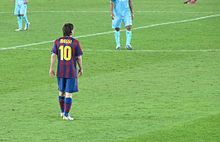
Messi playing against Atlante in the semi-finals of the 2009 FIFA Club World Cup on 16 December 2009
Messi was named winner of the 2009 Ballon d'Or on 1 December 2009, beating runner-up Cristiano Ronaldo by largest ever margin of 473 to 233.[80][81][82] He also placed second in the 2009 IFFHS World's Best Playmaker Award,[83] behind team mate Xavi.
On 19 December, Messi scored the winner in the final of the 2009 Club World Cup against Estudiantes in Abu Dhabi, giving the club their sixth title of the year.[84] Two days later, he was given the FIFA World Player of the Year award, beating Cristiano Ronaldo, Xavi, Kaká andAndrés Iniesta.[85] This was the first time he had won the award, and he became the first Argentine to ever receive this honour.[86] On 10 January 2010, Messi scored his first hat-trick in 2010 and his first hat-trick of the season against CD Tenerife in the 0–5 victory, and on 17 January he scored his 100th goal for the club in the 4–0 victory over Sevilla FC.[87]
Messi scored a hat-trick against Valencia CF in a 3–0 home win,[88] and finally he scored another hat-trick against Real Zaragoza in a 4–2 away win,[89] becoming the first Barcelona player to score back-to-back hat-tricks in La Liga.[90] He played his 200th official match for Barcelona against CA Osasuna on 24 March 2010.[91]
On 6 April 2010, for the first time in Messi's career he scored four goals in a single match, netting the lot in a 4–1 home win over Arsenal in the Champions League quarter-final second leg, which allowed him to finish the season as the competition's top scorer for the second consecutive year, with 8 goals.[92][93] This also saw him overtake Rivaldo as Barcelona's all time greatest scorer in the competition.[94] In the final league match of the season against Valladolid, he scored two goals in the second half to tie Ronaldo's club record of 34 goals in a single league season, set in 1996–97, and to finish four goals behind the all-time record which was held by Telmo Zarra.[95] He won the Pichichi trophy, and was also named La Liga player of the year for the second year in a row on 3 June 2010.[96] He finished the season with 47 goals in all competitions, tying Ronaldo's record from the 1996–97 season, and he provided 11 assists.[97]
2010–11 season
I feel sorry for those who want to compete for Messi's throne — it’s impossible, this kid is unique.
“
”
— Former Barcelona manager Pep Guardiola.[98]
On 21 August 2010, Messi scored a hat-trick in his first start of the season in a 4–0 victory over Sevilla FC in theSupercopa de España, helping Barcelona secure their first trophy of the season after a 1–3 first leg loss.
On 19 September 2010, Messi suffered an ankle injury due to an ill-advised tackle by Atlético Madrid defenderTomáš Ujfaluši in the 92nd minute of their Round 3 match at the Vicente Calderón Stadium. At first sight it was feared that Messi suffered a broken ankle that could have kept the star player away from the pitch for a minimum of six months, but MRI performed the next day in Barcelona showed he suffered a sprain in the internal and external ligaments of his right ankle.[99] Team-mate David Villa stated "the tackle on Messi was brutal" after watching the video of the play and also added that he believed the Atlético defender "didn't go into the tackle to hurt".[100] The incident caused widespread media attention and brought up the debate of equality in protecting all players in the game. Against UD Almería Messi scored his second hat-trick of the season in an impressive 8–0 away win, the second of which was his 100th La Liga goal.[101]

Messi trying to win the ball fromPepe during the Champions Leaguesemi-finals match against Real Madridon 27 April 2011
Messi won the 2010 FIFA Ballon d'Or, beating his Barcelona teammates Xavi and Iniesta.[102] Messi had been nominated for the awards for the fourth consecutive year.[103] On 5 February, Barcelona broke the record for most consecutive league wins with 16 victories after they defeated Atlético Madrid 3–0 at the Camp Nou.[104] Lionel Messi scored a hat-trick to ensure the victory for his side and after the match he stated, "it's an honor to be able to pass a record set by a great like "Di Stéfano" and "if the record has been around for so long is because it's very complicated to achieve and we have reached it by defeating a very difficult team who's going through a bad situation, which makes it even more difficult."[105]
After failing to score for a month he scored a brace against UD Almería; the second goal was his 47th of the season, equalling his club record return of the previous season.[106] He surpassed his record on 12 April 2011 by scoring the winner against Shakhtar Donetsk in a UEFA Champions League game, which put him in the record book as all time top scorer in a single season for Barcelona.[107] He scored his eighth goal on El Clásico on a 1–1 tie at the Santiago Bernabéu Stadium. On 23 April, Messi scored his 50th goal of the season against CA Osasuna in a 2–0 home victory which he came on as a substitute in the 60th minute.[108] He finished the season by winning La Liga and scoring 31 goals as he finished runner-up in the Pichichi trophy to Cristiano Ronaldo, who had managed to score 40. Messi finished the league season as the top assist provider with 18 assists.
On 20 April, Barcelona were defeated by arch-rivals Real Madrid in the 2011 Copa del Rey Final. Messi set up a goal for Pedro, which was however ruled offside. Cristiano Ronaldo scored the only goal of the match in extra time. Messi was however the joint top-scorer of the tournament along with Cristiano Ronaldo, with 7 goals.[109]
In the first leg of the Champions League semi-finals, he gave a memorable performance, scoring twice against Real Madrid in a 2–0 win, the second goal (a dribble past several players) being acclaimed as one of the best ever at that stage of the competition.[110][111] At the Champions League Final at Wembley, Messi scored the eventual game-clinching goal to give Barcelona their third title in six years and fourth overall.[112] This was also Messi's 12th goal in the Champions League that season, which allowed him to tie Ruud Van Nistelrooy's record of 12 goals in a single European Cup season, after it was re-established as the UEFA Champions League, in 1992. The overall record of goals scored in a single European Cup Season, is José Altafini's record of 14 goals, which Messi did however equal in the following season. Messi finished the 2010–11 season with 53 goals and 24 assists in all competitions combined.
2011–12 season

Barcelona and Messi celebrate winning the 2011 FIFA Club World Cup.
Messi started the season by lifting the Spanish Supercup with Barcelona, scoring three goals and providing two assists in a 5–4 aggregate win against Real Madrid.[113] His vital interventions continued in the next official match played against Porto when he scored again following a weak back pass from Fredy Guarín before setting up Cesc Fàbregas to give Barcelona a 2–0 victory and the UEFA Super Cup,[114] then the only official competition that remained for him to score in.[115]
In August, Messi became the second highest goalscorer surpassing László Kubala on 194 goals, being behind only to César Rodríguezon 232 goals in all official competitions.[116]
On 28 September, Messi scored his first two Champions League goals of the season against BATE Borisov,[117] becoming Barcelona's second highest goalscorer in its history, tying László Kubala, at 194 goals in all official competitions.[118] He surpassed that record when he scored two goals against Racing Santander.[119] He became second in Barcelona's La Liga goalscorers list with 132 goals, one more than Kubala.[120] He scored his 200th Barcelona goal and two more as part of a hat-trick in his next game against Viktoria Plzeň in the Champions League.[121]

Messi playing against Al Sadd in the semi-finals of the 2011 FIFA Club World Cup on 15 December 2011
Messi scored twice in the Club World Cup Final against Santos and was recognised as the man of the match and also awarded theGolden Ball for his performance during the tournament.[122]
Messi won the 2011 UEFA Best Player in Europe Award, beating his Barcelona team-mate Xavi and Real Madrid's Cristiano Ronaldo. Messi won the 2011 FIFA Ballon d'Or, again beating his team-mate Xavi and Cristiano Ronaldo. By winning the FIFA Ballon d'Or again, Messi become the fourth player to win three Ballons d'Or, after Johan Cruyff, Michel Platini and Marco van Basten and the second player to win three consecutive Ballons d'Or, after Michel Platini (although two of his Ballons d'Or are FIFA Ballons d'Or, which he won consecutively). Messi also won the IFFHS World's Top Goal Scorer award, with 19 goals in 2011.[123]
On 19 February 2012, Messi, on his 200th La Liga appearance, scored four goals against Valencia CF in a 5–1 win.[124] On 7 March, Messi became the first player to score five goals in an UEFA Champions League match since the tournament's re-establishment in 1992, helping the defending champions Barcelona win 7–1 against Bayer Leverkusen.[124]
For the world of football, he [Messi] is a treasure because he is a role model for children around the world. In the space of half a metre, he can move right or left - it is like he has the ball attached to his body. Maradona was also a little bit like this, and it could be because they are both low centre of gravity.
“
”
—Dutch legend Johan Cruyff after Messi set a new goal-scoring record for Barcelona, March 2012.[125]
On 20 March, Messi scored three goals against Granada, making him FC Barcelona's leading goalscorer in official competitions, surpassing club legend César Rodríguez, who had previously held the record with 232.[125]
On 3 April, Messi scored two goals from penalty kicks against Milan in the second leg of the Champions League quarter-final, allowing him to surpass his personal record, joint with Ruud van Nistelrooy, of 12 goals in a single UEFA Champions League season. These goals allowed him to tie José Altafini's record of 14 goals in a single European Cup season in the 1962–63 season, before the tournament's re-establishment as the UEFA Champions League in 1992.[126] Messi was unable to score in the semi-finals, although he provided an assist in the second leg, as Barcelona were knocked out to eventual winners Chelsea. During the second leg match, Messi missed an important penalty, hitting the crossbar. The goal would have put Barcelona ahead on aggregate.
On 11 April, Messi scored his 61st goal of the season against Getafe CF, and made two assists.[127] On 2 May, Messi scored a hat-trick against Málaga CF surpassing Gerd Müller's record (67 goals in 1972–73) with 68 goals, and thus becoming the best goalscorer in history in one season in Europe.[128] It was the 21st multi-goal game of the season for Messi and his seventh La Liga hat-trick.[129] He then scored four goals on 5 May against RCD Espanyol to take his tally to an unprecedented 72 goals, in the process becoming only the second player to pass 70 goals in a first division season since Archie Stark of Bethlehem Steel in the American Soccer League in 1924–25.[130]
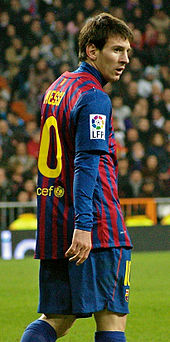
Messi playing against Real Madrid in a quarter-final match of the Copa del Rey on 18 January 2012
On 25 May, he scored again in the 2012 Copa del Rey Final, helping Barcelona win their 26th Spanish Cup title, and increasing his seasonal goalscoring record to an unmatched 73 goals in all competitions.[131] This was also Guardiola's last match as Barcelona's manager, and the Cup win marked Messi's second Copa del Rey title, after losing the final the year before, as well as his 14th Barcelona trophy during Guardiola's four seasons at the club. Although Barcelona failed to win their fourth consecutive Liga title under Guardiola, finishing runners-up to arch-rivals Real Madrid, Messi finished the 2011–12 season as the top goalscorer in La Liga for a second time, with a La Liga record of 50 goals. He was the second best assist provider in La Liga that season with 16 assists, after Mesut Özil, who managed 17. He also ended the season as the UEFA Champions' League Top Scorer for a fourth consecutive time, with 14 goals.[131] He was one of the top assist providers of the tournament with 5 assists and finished the season with 73 goals and 29 assists in all club competitions, with more goals and assists than any other player.
2012–13 season
During Barcelona's first game of the season against Real Sociedad, Messi continued his goalscoring run with a brace in a 5–1 win at the Camp Nou. Messi added another goal from a penalty in a 3–2 win against rivals Real Madrid in the first leg of the 2012 Supercopa de España in Barcelona on 23 August.[132] He added another brace against CA Osasuna as Barcelona came from behind away from home to beat them 2–1. Messi added another goal from a free kick in the second leg of the Supercopa de España, as Barcelona, down to ten men, were defeated by Real Madrid on away goals.[133] This marked his 15th goal in the El Clásico Real Madrid-Barcelona derby, which made him Barcelona's top scorer in Clasico matches, putting him tied with Raúl, behind only Alfredo Di Stefano, with 18 goals.[134] Messi placed second along with Cristiano Ronaldo in the 2012 UEFA Best Player in Europe Award, with 17 votes each. The award was won by Messi's Barcelona team mate Andrés Iniesta.[135] In his third league appearance on 2 September against Valencia CF, Messi assisted the only goal of the match, by team mate Adriano, from a short corner. Messi scored two more goals in a win against Getafe on 15 September[136] and added another brace in his first Champions League match of the season against Spartak Moscow on 20 September, ending in a 3–2 win to Barcelona, also marking his tenth goal of the season.[137]
On 11 November, Messi scored twice at RCD Mallorca, his 75th and 76th goals in 2012, surpassing Pelé's milestone of 75 goals (1958) in a calendar year, and moved within nine of German legend Gerd Müller's all-time Guinness World Records title.[138] His 77th and 78th goals came against Real Zaragoza at Camp Nou which moved Messi seven goals away from the record.[139] On 20 November, Messi scored twice at Spartak Moscow, his 79th and 80th goals of 2012 and moved to within five goals of the record.[140] Messi continued his scoring run against Levante UD on 25 November with his 81st and 82nd goals of the year which moved him within three goals of Müller.[141] On 1 December, Messi scored twice against Athletic Bilbao, his 83rd and 84th goals of the year, meaning he pulled to within one goal of Müller's record set in 1972. The two goals also meant Messi equaled the record for Barcelona's all time leading goalscoring record in La Liga, which was held by César Rodríguez with 190 goals.[142] On 9 December, Messi scored twice against Real Betis, his 85th and 86th goals in 2012, surpassing Müller's milestone of 85 goals scored in a calendar year in 1972 with Bayern Munich and the German national team, as well as surpassing Rodríguez's record for most league goals for Barcelona.[143][144] Messi sent Müller a No.10 Barcelona shirt, signed "with respect and admiration", after breaking his record.[145] On 12 December, Messi increased his record to 88, after scoring twice against Córdoba CF in the first leg of a Copa del Rey game. On 16 December, Messi scored twice in a 4–1 Barcelona victory against Atlético Madrid, increasing his record to 90 goals.[146] The tally found its end at 91 goals in a year after Messi scored once against Real Valladolid. FIFA, however, refuses to acknowledge the record for the most goals in a calendar year, citing verifiability issues.[147] On 18 December 2012, it was announced that Barcelona would renew the contract of Messi, extending it until 30 June 2018.[148] The contract was signed 7 February 2013.[149]
On 7 January 2013 odds-on favourite[150] Messi won the 2012 FIFA Ballon d'Or, again beating Cristiano Ronaldo into second place with team-mate Andrés Iniesta third. In doing this, Messi became the only player in history to win the Ballon d'Or four times.[151] Messi described receiving the accolade as "really quite unbelievable" and "too great for words".[152] The achievement fuelled media comparison of Messi with former greats of the sport such as Diego Maradona and Pelé.[153][154]
On 27 January 2013, Messi scored 4 goals in a 5–1 win against Osasuna, including his 200th goal in La Liga, becoming the eighth and youngest player to do so.[155] This brought his La Liga tally for the season up to 33, and his goalscoring total to 44 goals in all competitions. On 16 February 2013, Messi scored his 300th Barcelona goal the La Liga match against Granada CF, later scoring again in the match to bring his tally to 301 goals in 365 official matches.[156][157][158] On 2 March 2013, Messi scored a goal against Real Madrid in a match that Barcelona lost 2–1. With that goal, Lionel Messi equalled Alfredo Di Stefano's Clasico goals record of 18.[159] On 9 March 2013, Messi scored after coming on as a substitute against Deportivo de La Coruña, scoring in his 17th consecutive league match and breaking the all-time world record.[160] Messi's record goalscoring run of 33 goals in 21 games ended against Atletico Madrid.[161]
On 12 March, Messi scored two goals, and helped create the fourth, to help Barcelona defeat Milan (4–0) in the second leg of their Champions League game and reach the quarter-finals.[162] Messi's opening goal against Milan once again drew further comparisons between himself and Diego Maradona, due to the similarity between Messi's opening goal of the match and Maradona's famous goal against Greece in the 1994 World Cup. On 17 March 2013, in a match against Rayo Vallecano, Messi wore the captain's armband for the first time in an official match for Barcelona, taking over after Andrés Iniesta was substituted.[163] On 30 March, Messi scored for the 19th consecutive La Liga game, netting Barcelona's second goal at Celta de Vigo and thus becoming the first footballer in La Liga's history to score in consecutive matches against every team.[164]
On 2 April 2013, after scoring a goal in a match against Paris Saint-Germain, Messi suffered from a hamstring problem in his left leg and was substituted at half time.[165] Since then his first team appearances have been irregular. On 13 May 2013, Messi was unable to finish the match against Atletico Madrid due to recurrence of the hamstring injury in his left leg, he was forced to leave the field midway through the second half.[166] It was later announced that he could miss the rest of the season due to the injury.[167] In the second leg of the Champions League quarter-final against Paris Saint-Germain, Barcelona were down a goal, and Messi was on the bench due to a recurring injury problem. In the second half, Messi came off the bench and combined with David Villa to help create Pedro's game tying goal for Barcelona, which allowed them to progress to the semi-finals.[168] Barcelona were eliminated in the semi-finals by the eventual winners of the competition, Bayern Munich. Barcelona were also eliminated in the semi-finals of the Copa del Rey, by arch-rivals Real Madrid. Barcelona, however, managed to regain the La Liga title from Real Madrid, equalling their record 100 point campaign, which had been accomplished during the previous season.[169] Messi once again finished as La Liga's top scorer for the second consecutive year, with 46 goals, also producing 12 assists in the competition. Messi scored 60 goals and provided 16 assists in all competitions that season.
2013–14 season

Messi preparing to take a free-kick in La Liga match against Almeria.
Messi was nominated for the UEFA Best Player in Europe Award, along with Cristiano Ronaldo and Franck Ribéry, for a third consecutive year.[170] Ribéry won the award with 36 votes. Messi finished in second place with 14 votes, while Ronaldo finished in third-place with 3 votes.[171][172] On 18 August 2013, Messi opened the 2013–14 La Liga Season with two goals and an assist against Levante UD, as Barcelona went on to win the match 7–0.[173] On 28 August, Barcelona claimed their 11th Supercopa de España title over Atlético Madrid on away goals.
On 1 September, Messi scored his 23rd career hat-trick in a 3–2 win against Valencia CF. With these goals he became the player to score 100 away goals and become highest scorer in away fixtures in the league's history.[174] These goals made him the sixth-highest goalscorer in the history of La Liga, surpassing Quini's tally of 219.[175][176] On 18 September 2013, Messi scored his 24th career hat-trick in Barcelona's first Champions League win of the season, at home against Ajax, which ended 4–0. The goals made him the second-highest goalscorer of all time in the Champions League, with 62 goals, only behind Raúl, and the fourth-highest goalscorer of all time inEuropean Competitions, with 63. With this hatrick Messi became the first player to score four hat tricks in the Champions League.[177] On 10 November, Messi suffered an injury in a 4–1 away win against Real Betis, which would keep him sidelined until January 2014. This was his third injury of the season.[178]
On 8 January 2014, Messi returned from injury to score twice for Barça in a 4–0 Copa del Rey win against Getafe.[179] On 13 January, he placed second in the 2013 FIFA Ballon d'Or, behind Cristiano Ronaldo.[180] On 15 February, Messi scored twice against Rayo Vallecano in a 6–0 win to overtake fellow ArgentineAlfredo di Stéfano and draw level with Raúl as the third-highest goalscorer in La Liga history with 228 goals.[181]
On 16 March 2014, Messi scored a hat-trick in a 7–0 defeat of Osasuna to overtake Paulino Alcántara as Barça's top goalscorer in all competitions, including friendlies.[182] On 23 March, he scored a hat-trick in a 4–3 win against Real Madrid at the Santiago Bernabéu to become the outright all-time top goalscorer in El Clásico fixtures, ahead of Di Stefano.[183] These goals also enabled him to become the second highest goalscorer in La Liga, overtaking Hugo Sánchez.[184]
Messi finished his club season with only one trophy, the Spanish Super Cup, as Barcelona finished as runners-up in La Liga, behind Atletico Madrid, who had also eliminated them in the quarter-finals of the Champions League that season. Barcelona were also defeated in the Copa del Rey final by rivals Real Madrid, although Messi was the top scorer in the competition. Messi concluded the season with 41 goals and 15 assists in all competitions, but his 28 league goals in La Liga were not enough for him to defend the Pichichi trophy, which went to Cristiano Ronaldo, who managed 31 goals.[185] On 16 May 2014, Messi agreed a new contract with the Catalan club.[186]
2014–15 season

Messi celebrating scoring a goal against Granada CF in October 2014.
Messi opened the 2014–15 La Liga season for Barcelona by scoring twice in a 3–0 win over Elche CF.[187] In the following match againstVillareal CF, he set up Sandro's match-winning goal, although he suffered an injury to an abductor muscle in his right hip.[188] On 27 September, Messi scored his 400th professional career goal, aged just 27, in a 6–0 home win over Granada CF; he later added a second, and also provided two assists during the match.[189] In a post-match news conference he was lauded by his coach Luis Enrique, who stated: "It's like Messi was touched by a magic wand."[190]
On 18 October, Messi scored his 250th La Liga goal in a 3–0 home win over SD Eibar, also assisting another goal. This goal took him to one strike from equalling Telmo Zarra's all-time record of 251 La Liga goals.[191] Messi had previously celebrated the 10th anniversary of his club debut that week, on 16 October.[192] On 5 November, he scored both goals in Barcelona's 2–0 victory over Ajax, enabling his team to advance to the knock-out stage of the Champions League with two group games remaining. These goals increased Messi's tally to 71 goals in the competition, equalling Raúl's UEFA Champions League goal-scoring record.[193] Messi scored a hat-trick in a 5–1 win over Sevilla on 22 November to become the all-time top scorer in La Liga with 253 goals, breaking the record of 251 held by Telmo Zarrasince 1955.[194] Three days later, he scored another hat-trick in a 4–0 win over APOEL to become the outright top scorer in the history of the UEFA Champions League with 74 goals.[195]
On 7 December 2014, Messi scored his third consecutive hat-trick in Barcelona's 5–1 home win over local rivals RCD Espanyol, which allowed him to surpass Cesár as the top goalscorer in the Derbi barceloní, with 12 goals.[196] On 11 January 2015, Barcelona's "holy trinity" of Messi, Neymar and Luis Suárez scored in a 3–1 home win over defending La Liga champions Atlético Madrid. Messi's goal enabled him to end his goal drought against the Madrid club; he also set up Suárez's goal during the match.[197] On 12 January 2015, Messi placed second in the 2014 FIFA Ballon d'Or, behind Cristiano Ronaldo, for the second consecutive year.[198]
On 8 February, Messi scored a goal and made his 104th and 105th La Liga assists in a 2–5 away win over Athletic Bilbao, equalling the record held by Luís Figo for the most assists made in La Liga history.[199] In the next League game, on 15 February, his 300th La Liga appearance, he scored a hat-trick and made his 106th La Liga assist in a 5–0 home win over Levante, surpassing Figo as the player with most assists in La Liga;[200][note 1] he also drew level with Zarra for the most hat-tricks scored for a Spanish team in all competitions (31), and with Cristiano Ronaldo, for the most hat-tricks in La Liga (23).[201] On 8 March, Messi scored a 12-minute hat-trick, the fastest of his career, and also set up another goal in a 6–1 win over Rayo Vallecano at the Camp Nou.[202] With this hat-trick, he equalled Ronaldo's 30 goals in the current season, and also surpassed the record of Zarra with the most hat-tricks for a Spanish club in all competitions, and surpassed Ronaldo's record with the most hat-tricks in La Liga.[203]
On 18 April, Messi scored his 400th goal for Barcelona in a 2–0 home win over Valencia in La Liga, also setting up Suárez's opening goal.[204] On 6 May, Messi scored twice and assisted another as Barcelona defeated Bayern Munich 3–0 in the first leg of the Champions League semi-final at the Camp Nou; this was his 77th goal in his 100th appearance, overtaking Cristiano Ronaldo as the UEFA Champions League all-time top scorer in the process.[205] On 17 May 2015, Messi scored the only goal in a 1–0 win over Atlético Madrid at the Vicente Calderón Stadium, which allowed Barcelona to clinch the La Liga title.[206] On 30 May, he scored twice as Barça defeated Athletic Club 3–1 at Camp Nou in the 2015 Copa del Rey Final to win the domestic double for the second time in his career.[207]
On 6 June 2015, Messi started for Barça in the 2015 UEFA Champions League Final, as the club won its fifth European Cup by beating Juventus 3–1 at Berlin's Olympiastadion. Although he went scoreless throughout the match, he participated in each of his team's goals; in the 68th minute, he forced a parried save from Gianluigi Buffon, from which Suárez subsequently scored the match-winning goal on the rebound.[208] The victory made FC Barcelona the first club in history to win the treble of the domestic league, domestic cup and European Cup twice.[209] Messi, Andrés Iniesta, Xavi Hernández, Gerard Piqué, Pedro Rodríguez, Sergio Busquets and Dani Alves are the only players to have been a part of both treble winning teams.[209]
Messi ended the 2014–15 season with 43 goals and 18 assists in La Liga, making him the league's highest assister, and the second highest scorer behind Cristiano Ronaldo.[210]He was joint top scorer in the Champions League alongside Cristiano Ronaldo and Neymar,[211] and was also the highest assist provider, with 6 assists.[212] The forward line of Messi, Neymar and Luis Suárez ended with 122 goals, the highest for a season by a Spanish team in history, Messi himself scoring the most with 58 goals.[213]
International career
Often referred to as an Argentine-Spanish player, this crossover was brought into sharp focus when in 2004, Messi was offered the chance to play for the Spanish national U-20 team. He declined the offer given his Argentine heritage, and was given the opportunity to play for Argentina's U-20 team in a friendly match against Paraguay in June 2004.[214]Messi scored once against Paraguay and twice in friendly against Uruguay the following month.[215] In 2005 he was part of a team that finished third in the South American Youth Championship in Colombia. He won the 2005 FIFA World Youth Championship in the Netherlands with the team and received both the Golden Ball and the Golden Shoe,[216]having scored in the last four of Argentina's matches and netting a total of six for the tournament.
At age 18, Messi made his full international debut on 17 August 2005 against Hungary. He was substituted on during the 63rd minute, but was sent off on the 65th minute because the referee, Markus Merk, claimed that Messi had allegedly elbowed defender Vilmos Vanczák, who was tugging Messi's shirt. The decision was contentious and Diego Maradona even claimed the decision was pre-meditated. Messi was later reportedly found weeping in the changing rooms after the decision.[217][218] Messi returned to the team on 3 September in Argentina's 1–0 World Cup qualifier away defeat to Paraguay. Ahead of the match he had said, "This is a re-debut. The first one was a bit short."[219] He then started his first game for Argentina in a World Cup qualifier against Peru, in which he was able to win a crucial penalty for Argentina to win the match; after the match national coach José Pékerman described Messi as "a jewel".[220] He scored his first goal for Argentina in a friendly match against Croatia on 1 March 2006.[221]
2006 World Cup
An injury that kept Messi from playing for two months at the end of the 2005–06 season jeopardised his presence in the 2006 World Cup. Nevertheless, Messi was selected in the Argentina squad for the tournament on 15 May 2006. He also played in the final match before the World Cup against the Argentine U-20 team for 15 minutes and a friendly match against Angola from the 64th minute.[222][223] He witnessed Argentina's opening match victory against Ivory Coast from the substitutes' bench.[224]
In the next match against Serbia and Montenegro, Messi became the youngest player to represent Argentina at a World Cup when he came on as a substitute for Maxi Rodríguez in the 74th minute.[225][226] He assisted Hernán Crespo's goal within minutes of entering the game and also scored the final goal in the 6–0 victory, making him the youngest scorer in the tournament and the sixth youngest goalscorer in the history of the World Cup.[226] Messi started in Argentina's following 0–0 draw against theNetherlands.[227] In the following game against Mexico, Messi came on as a substitute in the 84th minute, with the score tied at 1–1. He appeared to score a goal, but it was ruledoffside with Argentina needing a late goal in extra time to proceed.[228][229] José Pekerman left Messi on the bench during the quarter-final match against Germany, which they lost 4–2 on a penalty shootout.[230]
2007 Copa América
Messi played his first game in the 2007 Copa América on 29 June 2007, when Argentina defeated United States 4–1 in the first game. In this game, he showed his capabilities as a playmaker. He set up a goal for fellow striker Hernán Crespo and had numerous shots on target. Carlos Tevez came on as a substitute for Messi in the 79th minute and scored minutes later.[231]
Messi in a semi-final match againstPeru during the 2007 Copa América on 8 July 2007
His second game was against Colombia, in which he won a penalty that Crespo converted to tie the game at 1–1. He also played a part in Argentina's second goal as he was fouled outside the box, which allowed Juan Roman Riquelme to score from a free kick, and increase Argentina's lead to 3–1. The final score of the game was 4–2 in Argentina's favor and guaranteed them a spot in the tournament's quarter-finals.[232]
In the third game, against Paraguay the coach rested Messi having already qualified for the quarter-finals. He came off the bench in place of Esteban Cambiasso in the 64th minute, with the score at 0–0. In the 79th minute, he assisted a goal for Javier Mascherano.[233] In the quarter-finals, as Argentina faced Peru, Messi scored the second goal of the game, from a Riquelme pass in a 4–0 win.[234] During the semi-final match against Mexico, Messi scored a lob over Oswaldo Sánchez to see Argentina through to the final with a 3–0 win.[235]Argentina went on to lose 3–0 to Brazil in the final.[236] Messi was elected young player of the tournament.[237]
2008 Summer Olympics
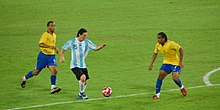
Messi playing against Brazil in the semi-finals of the 2008 Olympics on 19 August 2008
Having barred Messi from playing for Argentina in the 2008 Olympics,[238] Barcelona agreed to release him after he held talks with newly appointed coach Pep Guardiola.[239] He joined the Argentina squad and scored the first goal in a 2–1 victory over Ivory Coast.[239] He then scored the opening goal and assisted Ángel Di María in the second to help his side to a 2–1 extra-time win against the Netherlands.[240] He also featured in Argentina's match against rivals Brazil, in which Argentina took a 3–0 victory, thus advancing to the final. In the gold medal match, Messi again assisted Di María for the only goal in a 1–0 victory overNigeria.[241]
2010 World Cup qualification
On 28 March 2009, in a World Cup qualifier against Venezuela, Messi wore the number 10 jersey for the first time with Argentina. This match was the first official match for Diego Maradona as the Argentina manager. Argentina won the match 4–0 with Messi opening the scoring.[242] Overall, Messi scored four goals in 18 appearances during the South American 2010 World Cup qualifying process.[243]
2010 World Cup

Messi and Argentina lost 4–0 against Germany in the quarter-finals of the 2010 FIFA World Cup.
In the 2010 FIFA World Cup, Messi wore the number 10 shirt for the first time in a major tournament. He played the entire game on Argentina's opening match of the tournament, the 1–0 victory against Nigeria. He had several opportunities to score but was repeatedly denied by Nigerian goalkeeper Vincent Enyeama,[244] who was named man of the match by FIFA.[245] Messi started in Argentina's following 4–1 win against Korea Republic; he played in more of an attacking midfielder and playmaking role under Maradona,[246][247] and participated in all of the goals of his team, helping Gonzalo Higuaín score a hat-trick.[248] In the third group match, Messi was namedcaptain for Argentina in a 2–0 win over Greece. He was again the centrepoint of Argentina's play, playing an important role in both of his team's goals,[249] and was voted man of the match.[250]
At the Round of 16 he assisted a controversial goal to Carlos Tevez for the first goal in a 3–1 win against Mexico. The World Cup ended for Argentina with a 4–0 loss against Germany in the quarter-finals.[251]
Messi was nominated in ten player shortlist for Golden Ball award by FIFA Technical Study Group. The group identified Messi with the following words: "Outstanding in his pace and creativity for his team, dribbling, shooting, passing – spectacular and efficient".[252]
2011 Copa América

Messi (right) challenging Granit Xhaka for the ball during an international friendly betweenSwitzerland and Argentina on 29 February 2012
On 17 November 2010, Messi scored a last-minute goal against South American rivals Brazil after an individual effort to help his team to a 1–0 win in the friendly match, which was held in Doha. This was the first time that he had scored against Brazil at senior level.[253] Messi scored another last-minute goal on 9 February 2011 against Portugal from a penalty kick which gave his side a 2–1 victory in the friendly match, which was held in Geneva, Switzerland. He had also previously assisted the first goal.
Messi took part in the 2011 Copa América in Argentina, where he failed to score a goal but made three assists, finishing as the joint top assist provider of the tournament.[254] He was selected as man of the match in the group matches against Bolivia (1–1) and Costa Rica(3–0). Argentina were eliminated in the quarter-finals in a penalty shoot-out against the eventual winners of the Copa América, Uruguay (1–1 a.e.t.), with Messi scoring as the first penalty taker.[255] Messi had also previously assisted Higuaín's equaliser in the 17th minute.[255]
2014 World Cup qualification
After Argentina's unsuccessful performance in the Copa América, Sergio Batista was replaced as Argentina coach with Alejandro Sabella. In August 2011, Sabella named Messi as the new permanent captain of the Argentina national team.[256] Messi's first hat-trick for theAlbiceleste came in a friendly match against Switzerland, on 29 February 2012, in a 3–1 win for Argentina.
On 9 June 2012, Messi scored his second international hat-trick in a friendly match against rivals Brazil, including the match winner. The match ended 4–3 to Argentina and Messi was voted man of the match.[257] This brought his international goalscoring tally up to 26 goals in 70 matches, and brought his 2012 tally up to 7 goals in 3 matches. This was also his record-breaking 82nd goal of the season, including all club and international matches.[258]These goals also made him the fourth-highest goalscorer for the Argentine national team.[259]
On 7 September, Messi scored his 28th goal for Argentina in a 3–1 victory against Paraguay in a 2014 World Cup qualifying match, sending them to the top of the CONMEBOLWorld Cup qualifying table. This was his fourth goal in the current World Cup qualifying campaign and his eighth overall in World Cup qualifying matches, making him the third-highest scorer for Argentina in World Cup qualifying matches. This was also his tenth goal for Argentina in the past six matches and his ninth in five matches played in 2012.[260]After scoring twice against Uruguay and once against Chile in October, Messi finished 2012 with 12 goals in nine appearances for Argentina.[261]
On 22 March 2013, Messi scored his first international goal of 2013 from the penalty spot in a World Cup qualifier against Venezuela. In the same match he provided two assists for Gonzalo Higuaín as Argentina won 3–0.[262] On 14 June 2013, Messi scored a hat-trick in a 4–0 friendly win against Guatemala, surpassing Diego Maradona's 34 goals onArgentina's all-time top scorer's list and matching Hernán Crespo for second with 35 goals.[263] Messi surpassed Crespo's tally in the 2014 World Cup qualifier against Paraguay, scoring two goals from penalties as well as providing an assist for Sergio Agüero. The match finished 5–2 to Argentina, ensuring their qualification for the 2014 World Cup with two matches at hand. Messi ended the 2014 FIFA World Cup qualification campaign as second-top scorer in the South American section with ten goals.[264] On 7 June 2014, Messi scored in a 2–0 win against Slovenia in a pre-World Cup friendly match, coming on as a substitute; this was his first goal for his national side in the year 2014.[265]
2014 World Cup
Messi captained Argentina in their first match of the 2014 FIFA World Cup, leading them to a 2–1 win over Bosnia and Herzegovina on 15 June.[266] Argentina's opening goal came after three minutes when Messi's cross into the box from a free kick was met by Argentina defender Marcos Rojo whose header was deflected into the net by Sead Kolašinac.[266] In the 65th minute, Messi scored Argentina's second, going on a trademark dribbling run past three players, after a one-two exchange with Higuaín, before scoring from the edge of the penalty area via a slight deflection off Mensur Mujdža.[267] It was his first World Cup goal since scoring against Serbia and Montenegro on his World Cup debut in a 6–0 win in the 2006 tournament. In the team's second game, Messi scored a stoppage time winner against Iran with a strike from 25 yards out which curled into the left corner of the goal.[268] This was Messi's 40th international goal, and the 1–0 win ensured Argentina qualified for the knockout stage.[269][270] In the team's third group match on 25 June, Messi took his tally in the tournament to four goals, scoring twice in a 3–2 win against Nigeria, his second a free kick, as Argentina finished first in their group.[271] Messi was elected man of the match in all three of Argentina's group games.[272][273][274]

Messi battling Germany's Mats Hummels for the ball at the 2014 FIFA World Cup Final
In Argentina's round of 16 match against Switzerland, Messi assisted Ángel Di María's match winning goal in the 118th minute, giving Argentina a 1–0 win after extra time. After receiving the ball from Rodrigo Palacio, Messi began a dribbling run, taking it past Fabian Schär, and laying the ball off for Di María to score.[275] Messi was once again elected man of the match.[276] In the quarter-final match against Belgium, Messi started the play which led to Higuaín's match winning goal, sending Argentina to the semi-finals of the World Cup for the first time since 1990.[277] Argentina eliminated the Netherlands, 4–2 on penalties in the semi-final, after a 0–0 draw following extra time, allowing them to progress to the World Cup Final for the first time since Maradona had led them there in 1990. Messi was heavily marked by the Dutch and didn't score,[278] but he netted Argentina's first penalty in the shootout.[279]

Messi (bottom left) and members of the Argentina national team with Argentina president Cristina Kirchneron 14 July after the 2014 FIFA World Cup
On 11 July, Messi was named on the 10-man shortlist by the FIFA technical committee for FIFA'sGolden Ball award for the tournament's best player.[280] The World Cup final match on 13 July, in a repeat of the 1990 final, was billed as the world's best player [Messi] versus the world's best team [Germany].[278][281] In the 29th minute, Messi had started a play which led to a goal by Higuaín, which was correctly ruled offside. Messi missed several opportunities to open the scoring throughout the match, in particular during his breakaway at the 47th minute, when his effort was put just wide of the far post. The game remained scoreless until German substitute Mario Götze scored in the 113th minute, then in the last minutes of extra time Messi's free kick sailed over the net, and Germany won the game 1-0 to claim the World Cup.[282]
Messi finished as the joint-third-highest goalscorer of the tournament, with four goals and an assist, though Neymar received the Bronze Boot due to the tie-breaking criteria of playing fewer minutes than Messi. Messi's goals against Nigeria and Bosnia and Herzegovina were nominated for the goal of the tournament award, and were voted the ninth and eighth best goals of the tournament, respectively.[283]Messi's four Man of the Match awards were the most of any player in the tournament.[284]
At the conclusion of the World Cup final, Messi was awarded the Golden Ball, as the tournament's best player, ahead of Thomas Müllerand Arjen Robben, and was named in the FIFA World Cup All-Star Team. Messi created the most chances, made the most successful dribbling runs, made the most deliveries into the box, and produced the most throughballs of any other player throughout the World Cup.[285] However, the decision to award Messi the Golden Ball sparked controversy amongst the media, as Messi had no goals during the knockout round. FIFA President Sepp Blatter was surprised at the choice of Messi for the Golden Ball, while Argentina's former captain and coach Diego Maradona suggested that "marketing people" had chosen the wrong player for the award.[286][287] On his award and the final, Messi commented: "I do not care about the Golden Ball. I am just upset by the wasted chances. We had the best chances. We knew we could not dominate the game but we knew what we wanted to do. Right now I do not care about my prize. I just wanted to lift the cup and bring it to Argentina. The pain is very great."[288]
2015 Copa América
On 13 June 2015 Messi scored from a penalty kick in Argentina's opening fixture of the 2015 Copa América, a 2–2 draw with Paraguay in La Serena.[289] Messi was named man of the match in Argentina's 1–0 victory over defending champions Uruguay in their second group match, on 16 June.[290] In the final group game against Jamaica at the Estadio Sausalito in Viña del Mar on 20 June, Messi earned his 100th cap, becoming the fifth Argentine to do so after Javier Zanetti, Javier Mascherano, Roberto Ayala and Diego Simeone.[291] On 27 June, Messi netted a penalty in Argentina's 5–4 penalty shoot-out victory over Colombia in the quarter-finals of the tournament, following a 0–0 draw.[292]During Argentina's 6–1 defeat of Paraguay at the semi-final stage, he became the first player at the 2015 tournament to assist three goals in a game.[293] On 4 July, Messi was the only Argentine to convert his kick in Argentina's 4–1 penalty shoot-out defeat to hosts Chile in the 2015 Copa América final, after a 0–0 draw.[294]
Style of play

Messi, playing for Argentina in 2011, has been compared to compatriot Diego Maradona and two-timeFIFA/Ballon d'Or winner,Cristiano Ronaldo.
Messi has been compared to compatriot Diego Maradona, due to their similar playing style and stature,[295] which gives him a lower centre of gravity than most players, allowing him to be more agile and change direction more quickly, helping him to evade opposing tackles.[296] His short, strong legs allow him to excel in short bursts of acceleration and his quick feet allow him to keep control of the ball when dribbling at speed.[297]His former FC Barcelona manager, Pep Guardiola, once stated: "Messi is the only player that runs faster with the ball than he does without it."[298]Like Maradona before him, Messi is predominantly a left footed player;[299][300] during the 2014-15 season however, he was able to partially improve his ability with his weaker foot.[301] With the outside of his left foot, he usually begins dribbling runs, while he uses the inside of his foot to finish and provide passes and assists to team mates.[296] Messi is widely regarded as one of the best players of all time and, alongside Portuguese forward Cristiano Ronaldo, as one of the two best players in the world and of his generation.[4][6][7][8][302]
Due to his pace, stamina, and technical ability, Messi often undertakes individual dribbling runs towards goal, in particular during counterattacks, usually starting from the halfway line, or the right side of the pitch. However, he has also been described as a well-rounded, hard-working team player, known for his creative combinations, in particular with Barcelona midfield team mates Xavi and Iniesta.[303][304][305] He is also an accuratefree kick and penalty kick taker.[306] With regard to his dribbling ability, Maradona has said of Messi: "The ball stays glued to his foot; I’ve seen great players in my career, but I’ve never seen anyone with Messi's ball control."[296] Maradona considers Messi to currently be the greatest player in the world.[307][308] Despite being neither physically imposing nor dominant in the air, due to his small stature and physique, Messi possesses notable upper-body strength, which, along with his balance and control, aids him in protecting the ball and withstanding physical challenges from opponents.[309]
Tactically, Messi plays a free attacking role;[53] a prolific goalscorer, he is known for his finishing, skill, positioning, quick reactions,[310] and his ability to make attacking runs to beat the defensive line.[296] He also functions in a playmaking role, due to his vision and precise passing.[304][311] A versatile player, Messi is capable of playing anywhere along the front line, as he is comfortable attacking on either wing or through the centre of the pitch.[312] He began his career as a left-winger or as aleft-sided forward, but was later moved onto the right wing by former Barcelona manager Frank Rijkaard, who noticed that from this position, Messi could cut through the defence into the middle of the pitch more easily, allowing him to curl shots on goal with his left foot, rather than predominantly crossing balls for team mates.[313] He has more recently played as a striker, and in a "false 9" role under Guardiola.[314] This role is characterised by Messi's apparent tendency to play as a centre forward, or as a lone striker, although he will often run back into deep positions, drawing defenders with him. His movement creates space for wingers, other forwards, and attacking midfielders to make runs, allowing him to provide them with assists, or giving him space to begin dribbling runs, and score goals or create attacking plays.[314] With the Argentina national team, Messi usually plays anywhere along the front line. He began as a supporting forward, striker, or winger, but recently he has also played in a deeper, creative role, as an attacking midfieldplaymaker.[246][247]
Comparisons to Cristiano Ronaldo
Main article: Messi–Ronaldo rivalry

Messi with Cristiano Ronaldo before an international friendly betweenPortugal and Argentina in Geneva, Switzerland on 9 February 2011
Both players have scored in two UEFA Champions League finals and have regularly broken the 50 goal barrier in a single season. Both have scored over 400 goals in their career for club and country.[190][315] Sports journalists and pundits regularly argue the individual merits of both players in an attempt to argue who they believe is the best player in modern football.[316] It has been compared to legendarysports rivalries such as the Muhammad Ali-Joe Frazier rivalry in boxing which culminated with the Thrilla in Manila, the Borg–McEnroe rivalry in tennis, and the Ayrton Senna-Alain Prost rivalry from Formula One.[317][318]
Even before he [Ronaldo] signed for Madrid, I knew he would be my great rival in the following years.
“
”
— Messi commenting on his rivalry with Ronaldo.[319]
Some commentators choose to analyse the differing physiques of the two,[320] while part of the debate revolves around the contrasting personalities of the two players: Ronaldo is depicted as an arrogant and theatrical showoff, while Messi is portrayed as a shy, humble character.[321][322][323][324]
With Messi and Ronaldo representing bitter Spanish rivals Barcelona and Real Madrid, the two players face each other at least twice every season in the world's biggest club game, El Clásico, which had a global audience of 400 million viewers in March 2014.[325] Off the field, they are the face of two rival sportswear giants, Messi of Adidas and Ronaldo of Nike.[326] The two highest paid players in football, Ronaldo and Messi are among the world's best paid sports stars: in 2013, Ronaldo was second earning $80 million, and Messi was fourth with $64.7 million.[327] They have the two biggest social media followings in the world among sportspeople with a combined 138 million Facebook fans by May 2014.[325]
Many figures in the sport have cited Messi and Cristiano Ronaldo as being the two best players of their generation, such as Johan Cruyff,[328] Diego Maradona[329] and the Brazilian Ronaldo.[330] The two players have been named the world's best player by FIFA every year since 2008: FIFA World Player of the Year (Ronaldo 2008, Messi 2009) andFIFA Ballon d'Or (Messi 2010, 2011, 2012, Ronaldo 2013, 2014).[331] Cristiano Ronaldo's former Real Madrid manager, José Mourinho, once stated: "If both Messi and Cristiano Ronaldo were born in different eras, they would have ruled the football scene and collected 10 FIFA Ballon d'Ors each."[332]
Personal life

Messi during a Barcelona training session at the Camp Nou on 21 May 2009
Messi was at one stage romantically linked to Macarena Lemos, also from his hometown of Rosario. He is said to have been introduced to her by the girl's father when he returned to Rosario to recover from his injury a few days before the start of the 2006 World Cup.[333][334] He has in the past also been linked to the Argentine glamour model Luciana Salazar.[335][336]
In January 2009, he told "Hat Trick Barça", a programme on Canal 33: "I have a girlfriend and she is living in Argentina. I am relaxed and happy".[336]He was seen with the girl, Antonella Roccuzzo,[337] at a carnival in Sitges after the Barcelona-Espanyol derby. Roccuzzo is a fellow native of Rosario.[338] On 2 June 2012, Messi assisted and scored a goal in Argentina's 4–0 win against Ecuador in a World Cup 2014 Qualifying match. He celebrated scoring his 23rd goal for Argentina, by placing the ball under his jersey, as his girlfriend was reportedly 12 weeks pregnant. She posted onTwitter that she expected to give birth in September.[339] Messi stated that the child, a son, would be born in October, and that he and his girlfriend would name him Thiago.
However, the birth came later than expected. On 2 November 2012, Messi became a father for the first time following the birth of his son Thiago. FC Barcelona's official website briefly stated "Leo Messi is a father". Furthermore, the Argentine striker added on his Facebook page: "Today I am the happiest man in the world, my son was born and thanks to God for this gift!"[20][340] He also had the boy's name and handprints tattooed on his left calf.[341]
To celebrate his son's first birthday, Messi and Thiago were part of a publicity campaign for UNICEF.[342] Those who signed up and participated in the social-media campaign had the chance to win a pair of Messi's shoes or a signed Messi T-shirt.[342]
Messi has two cousins also involved in football: brothers Maxi and Emanuel Biancucchi, who play for Brazil's Bahia.[343]
In 2013, Messi, a devout Roman Catholic, met Pope Francis, himself a fan of Argentine club San Lorenzo, at the Vatican, with Messi stating; “Without a doubt, today was one of the most special days of my life. We have to excel on and off the field.”[344]
Messi has maintained close ties to Rosario and his family since leaving for Spain, and has gone to great lengths to maintain them. He keeps in daily contact via phone and text with a small group of confidants from Rosario, most of them fellow members of "The Machine of '87". One time when he was in training with the Argentina national team in Buenos Aires, he made a three-hour trip by car to Rosario immediately after practice to have dinner with his family, spent the night with them, and then returned to Buenos Aires the next day in time for practice. Messi has also kept ownership of his old house in Rosario, although his family no longer lives in it; he maintains a penthouse apartment in an exclusive residential building in which his mother lives (Messi's father spends most of his time in Spain with him), as well as a family compound just outside the city.[20]
Charity
In 2007, Messi established the Leo Messi Foundation, a charity supporting access to education and health care for vulnerable children.[345][346] In response to Messi's own childhood medical difficulties, the Leo Messi Foundation has offered Argentine children diagnosed with illnesses treatment in Spain and funds covering the transport, hospital and recuperation costs.[347] Messi's foundation is supported by his own fundraising activity with additional assistance from Herbalife.
On 11 March 2010, Messi was announced as a goodwill ambassador for UNICEF.[348] Messi's UNICEF ambassador activities are aimed at supporting children’s rights. Messi is supported in this by Barcelona, who also have a strong association with UNICEF.[349]
He and Newell's have also ended a long public feud. Messi funded the construction of a dormitory inside Newell's stadium for the club's youth academy, as well as a new gymnasium for the club. For their part, Newell's has begun to embrace their ties with Messi, and plans to issue a special club membership card to Messi's son.[20]
In March 2013, Lionel Messi donated €600,000 towards the refurbishment of a children's hospital in his hometown of Rosario, Argentina. The money was used to renovate the oncology unit at the Victor J Vilela Children's Hospital, as well as paying for doctors to travel to Barcelona for training.[350]
In January 2015, Messi teamed up with tennis star Serena Williams as ambassadors in a new campaign, called 1 in 11 (represents the number of children worldwide who are unable to attend school), the result of a collaboration between UNICEF, the F.C. Barcelona Foundation, and Reach Out To Asia (ROTA). The campaign's aim is to help children around the world reach their potential through sport and education by raising funds for education programmes.[351]
Wealth
In March 2010, France Football ranked Messi at the top of its list of the world's richest footballers, ahead of David Beckham and Cristiano Ronaldo, with €33 million ($45 million) in combined income from salaries, bonuses and off-field earnings for the previous 12 months.[352][353] In May 2014, Forbes ranked Messi second behind Cristiano Ronaldo in their list of the world's highest paid players with earnings of $65 million in the previous 12 months.[354]
Salary
In December 2012, Barcelona announced that Messi would sign a five-year contract extension which will keep him at the club until 2018 and raising his base salary to €16 million ($21.2 million) net, which will make him the highest on-field earner in football. As the tax bracket for this level of income in Spain is 56%, it means that Barcelona will have to pay Messi's income tax of a little over €20 million ($26.5 million).[355] His formal buy-out clause remains at €250 million.[356]
In September 2012, Messi became the global brand ambassador of Turkish Airlines.[357] Messi shot a commercial for the airline with NBA star Kobe Bryant. In the airline's latest commercial, the duo competes to win the attention of a young boy.[358] Messi appeared in a 2012 television advert for Japanese face wash Scalp-D.[359] In December 2013, Messi appeared in an advertisement for South Korean company Samsung, along with 10 other football players from around the globe, as the captain of a Galaxy XI managed by German football legend Franz Beckenbauer.[360]
In February 2014, Messi appeared in a Gillette advertisement with tennis star Roger Federer. He was announced as the global face of the company's international football campaign. Gillette has also become a partner of the Leo Messi Foundation to support its mission.[361]
Tax evasion
Messi's father, Jorge Horacio Messi, was under investigation for an alleged €4 million in unpaid taxes from 2007 to 2009. Messi and his father were accused of channelling funds through the United Kingdom and Switzerland, to a number of shell companies set up in tax havens of Belize and Uruguay, in order to shield royalties and other licensing income from Spanish income tax which allowed them to avoid paying around €4.165 million.[362][363]
The elder Messi made a payment of over €5 million in August 2013 to cover the unpaid taxes, plus interest. The prosecutor originally agreed that Jorge was responsible for the tax schemes and recommended that the charges be dismissed. However, a Barcelona court stated that there was sufficient evidence proving that the younger Messi should have known about and consented to the tax scheme and ordered them both to stand trial on tax evasion charges in autumn 2014.[364][365][366]
Media
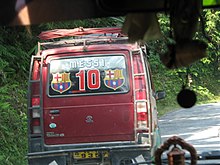
An example of Messi's popularity and influence, photographed in India
Messi was featured alone on the front covers of the video games Pro Evolution Soccer 2009 and Pro Evolution Soccer 2011 and was also involved in promotional campaigns for the games.[367][368] Messi, along with Fernando Torres,[369] was the joint face of Pro Evolution Soccer 2010, and was also involved in the motion capturing and the trailer.[370][371][372] This meant that Messi was the face and on the front cover of Pro Evolution Soccer from 2009 to 2011. However in November 2011, Messi was confirmed as the new face of PES's rival football series FIFA with his debut as a cover star of the series coming in 2012's FIFA Street. Messi was also chosen to be on the cover ofFIFA 13, FIFA 14, FIFA 15 and FIFA 16.[373] Messi is sponsored by the German sportswear company Adidas and features in their television advertisements.[374] In June 2010, Messi also signed a three–year contract with Herbalife which further supports the Leo Messi Foundation.[375]
Messi was named twice in the Time 100, Time magazine's annual list of the most influential people in the world, in 2011[376] and in 2012.[377] Within a few hours of its launch in April 2011, Messi's Facebook page had more than six million followers,[378] and in 2013, Messi became the second sportsperson, after Cristiano Ronaldo, to amass over 50 million followers.[379]
Messi ranked second behind Neymar in SportsPro magazine's 2013 list of the world's most marketable athletes.[10] Japanese jeweller Ginza Takana used a cast of Messi's left foot to create a solid gold replica, weighing 25 kilograms (55 lb), which went on sale in Japan in March 2013 to raise funds for victims of the 2011 Tōhoku earthquake and tsunami. It was valued at $5.25 million.[380]
In 2014, Messi was the subject of a documentary by filmmaker Álex de la Iglesia, titled Messi, which premiered at the Venice Film Festival in September.[381][382] On 12 February 2015, a photograph of Messi facing the World Cup Trophy during the final at Maracanã Stadium in which Argentina lost 1-0 to Germany, was voted 2014's best sports image in the World Press Photo of the Year, titled "The Final Game".[383]
Career statistics
Club
- As of match played 6 June 2015.
| Club | Season | League | Copa del Rey | Europe | Other | Total |
|---|
| Division | Apps | Goals | Apps | Goals | Apps | Goals | Apps | Goals | Apps | Goals |
|---|
| Barcelona C | 2003–04[27] | Tercera División | 10 | 5 | — | — | — | 10 | 5 |
| Barcelona B | 2003–04[384] | Segunda División B | 5 | 0 | — | — | — | 5 | 0 |
| 2004–05[385] | 17 | 6 | — | — | — | 17 | 6 |
| Total | 32 | 11 | — | — | — | 32 | 11 |
|---|
| Barcelona | 2004–05[385] | La Liga | 7 | 1 | 1 | 0 | 1[a] | 0 | — | 9 | 1 |
| 2005–06[386] | 17 | 6 | 2 | 1 | 6[a] | 1 | 0 | 0 | 25 | 8 |
| 2006–07[387] | 26 | 14 | 2 | 2 | 6[b] | 1 | 2[c] | 0 | 36 | 17 |
| 2007–08[388] | 28 | 10 | 3 | 0 | 9[a] | 6 | — | 40 | 16 |
| 2008–09[389] | 31 | 23 | 8 | 6 | 12[a] | 9 | — | 51 | 38 |
| 2009–10[390] | 35 | 34 | 3 | 1 | 12[d] | 8 | 3[e] | 4 | 53 | 47 |
| 2010–11[391] | 33 | 31 | 7 | 7 | 13[a] | 12 | 2[c] | 3 | 55 | 53 |
| 2011–12[392] | 37 | 50 | 7 | 3 | 12[f] | 15 | 4[g] | 5 | 60 | 73 |
| 2012–13[393] | 32 | 46 | 5 | 4 | 11[a] | 8 | 2[c] | 2 | 50 | 60 |
| 2013–14[394] | 31 | 28 | 6 | 5 | 7[a] | 8 | 2[c] | 0 | 46 | 41 |
| 2014–15[395] | 38 | 43 | 6 | 5 | 13[a] | 10 | — | 57 | 58 |
| Total | 315 | 286 | 50 | 34 | 102 | 78 | 15 | 14 | 482 | 412 |
|---|
| Career total | 347 | 297 | 50 | 34 | 102 | 78 | 15 | 14 | 514 | 423 |
|---|
- ^ Jump up to:a b c d e f g h Appearance(s) in UEFA Champions League
- Jump up^ One appearance in UEFA Super Cup, five appearances and one goal in UEFA Champions League
- ^ Jump up to:a b c d Appearances in Supercopa de España
- Jump up^ One appearance in UEFA Super Cup, 11 appearances and eight goals in UEFA Champions League
- Jump up^ One appearance and two goals in Supercopa de España, two appearances and two goals in FIFA Club World Cup
- Jump up^ One appearance and one goal in UEFA Super Cup, 11 appearances and 14 goals in UEFA Champions League
- Jump up^ Two appearances and three goals in Supercopa de España, two appearances and two goals in FIFA Club World Cup
International

Messi playing against Portugal in Geneva, Switzerland, on 9 February 2011
- As of match played 4 July 2015[215][397][398]
International appearances
International statistics
| Team | Year | Apps | Goals |
|---|
| Argentina | 2005 | 5 | 0 |
| 2006 | 7 | 2 |
| 2007 | 14 | 6 |
| 2008 | 8 | 2 |
| 2009 | 10 | 3 |
| 2010 | 10 | 2 |
| 2011 | 13 | 4 |
| 2012 | 9 | 12 |
| 2013 | 7 | 6 |
| 2014 | 13 | 8 |
| 2015 | 6 | 1 |
| Total | 103 | 46 |
|---|
Honours
Club
- Barcelona[399]
- La Liga: 2004–05, 2005–06, 2008–09, 2009–10, 2010–11, 2012–13, 2014–15
- Copa del Rey: 2008–09, 2011–12, 2014–15
- Supercopa de España: 2005, 2006, 2009, 2010, 2011, 2013
- UEFA Champions League: 2005–06, 2008–09, 2010–11, 2014–15
- UEFA Super Cup: 2009, 2011
- FIFA Club World Cup: 2009, 2011
International
- Argentina[399]
- FIFA World Youth Championship: 2005[399]
- Olympic Gold Medal: 2008[399]
- Copa América: Runner-up 2007, 2015
- FIFA World Cup: Runner-up 2014[395]
Individual
- Personal[399]
- FIFA Ballon d'Or: 2010, 2011, 2012
- Ballon d'Or: 2009
- FIFA World Player of the Year: 2009
- World Soccer Player of the Year: 2009, 2011, 2012
- World Soccer Greatest XI of All Time: 2013
- Onze d'Or: 2009, 2011, 2012
- European Golden Shoe: 2010, 2012, 2013
- UEFA Best Player in Europe Award: 2011
- UEFA Club Footballer of the Year: 2009
- UEFA Champions League Forward of the Year: 2009
- UEFA Champions League Top Goalscorer: 2009, 2010, 2011, 2012, 2015
- UEFA Champions League Team of the Season: 2014–15[400]
- UEFA Team of the Year: 2008, 2009, 2010, 2011, 2012, 2014
- 2011 UEFA Champions League Final: Man of the Match
- FIFA Club World Cup Golden Ball: 2009, 2011
- L'Équipe Champion of Champions: 2011
- La Gazzetta dello Sport Sportsman of the Year: 2011
- FIFA World Youth Championship Golden Ball: 2005[401]
- FIFA World Youth Championship Golden Shoe: 2005
- LFP Best Player: 2009, 2010, 2011, 2012, 2013
- La Liga Foreign Player of the Year: 2007, 2009, 2010
- Pichichi Trophy: 2010, 2012, 2013
- LFP Best Forward: 2009, 2010, 2011, 2012, 2013
- La Liga Ibero-American Player of the Year: 2007, 2009, 2010, 2011, 2012
- FIFPro World Young Player of the Year: 2006, 2007, 2008
- World Soccer Young Player of the Year: 2006, 2007, 2008
- Bravo Award: 2007
- Golden Boy: 2005
- Marca Legend Award: 2009
- Trofeo Alfredo Di Stéfano: 2008–09, 2009–10, 2010–11
- ESPY Awards Best International Athlete: 2012
- El País King of European Soccer: 2009, 2010, 2011, 2012[402]
- IFFHS World's Top Goal Scorer: 2011, 2012[403]
- IFFHS World's best Top Division Goal Scorer: 2012[404]
- FIFA/FIFPro World XI: 2007, 2008, 2009, 2010, 2011, 2012, 2013, 2014
- ESM Team of the Year: 2006, 2008, 2009, 2010, 2011, 2012, 2013
- Copa América Young Player of the Tournament: 2007
- Copa América Top Assist Provider: 2011
- Copa del Rey Top Goalscorer: 2010–11, 2013–14
- Argentine Sportsperson of the Year Award: 2011
- Olimpia de Plata: 2005, 2007, 2008, 2009, 2010, 2011, 2012, 2013
- FIFA World Cup Golden Ball: 2014[405]
- FIFA World Cup Dream Team: 2014[406]
- La Liga Team of the Season: 2014–15[407]
Records
- As of 24 March 2015
World
- Most FIFA Ballon d'Or awards: 4[408]
- Guinness World Records title for the most goals in a year (2012): 91 goals (96 goals including club friendlies)[409][410]
- Most international goals in a calendar year (2012): 25 (shared with Vivian Woodward and Cristiano Ronaldo)[411]
- Youngest two-time/three-time/four-time Ballon d'Or winner: 23/24/25 years[412]
- Most FIFA Club World Cup Golden Balls: 2 (2009,[413] 2011[414]) [415]
- Most appearances in the top 3 candidates for the Ballon d'Or: 8 times (2007-2014)[416]
- Most appearances in the FIFPro World XI: 8 times (2007-2014) (shared with Cristiano Ronaldo)[417]
Europe
- Most goals scored in a season (club): 73 goals[131]
- Most goals scored in a year (club): 79 goals[418]
- Most UEFA Champions League top scorer awards: 5[419]
- Most consecutive Champions League top scorer awards: 4[419]
- Most hat-tricks in UEFA Champions League: 5[177]
- Highest scorer in a UEFA Champions League game - shared with Luiz Adriano: 5 goals[420]
- Most goals scored in the UEFA Champions League: 77 goals (shared with Cristiano Ronaldo)[421][422]
Argentina
- Most goals scored in a year (national team): 12 goals (shared with Gabriel Batistuta)[423]
- Youngest player that have scored a goal at the FIFA World Cup: 18 years and 357 days old (2006 vs Serbia & Montenegro)[424]
- Most goals scored in International friendlies: 24
- Most goals scored, alongside Javier Saviola, in all U-20 International competitions (2004-2005): 11 goals (14 goals including friendlies)
- Most goals scored in one FIFA World Cup qualification (2014): 10[425]
Spain
- Most goals scored in La Liga history: 283 goals[426]
- Most assists made in La Liga history[200][427][428][429]
- Most goals scored in La Liga in a season: 50 goals[430]
- Most consecutive La Liga matches scored in: 21 matches (33 goals)[431][9]
- Most La Liga hat-tricks in a season (co-record): 8 hat-tricks (shared with Cristiano Ronaldo)[432]
- Youngest player to score 200 La Liga goals: 25 years[433]
- Most goals scored in El Clasico: 21[434]
- Most goals scored in Derbi barceloní matches: 12 goals[196]
- Most braces in La Liga history: 80[435]
- Most goals scored in the Supercopa de España: 10 goals[432]
- Only top goalscorer and top assists supplier in the same league season: 2011/12 (50 goals and 15 assists)[410]
- First player to score in every game for half of La Liga season (2012/13): 30 goals (in 19 consecutive Matches)[410]
- Highest goalscoring average in a La Liga Season (2012/2013): 1,44 goals/game (46 goals in 32 matches)
- Most Home goals in a league season (2011/12): 35 goals (in 19 Home matches)[410]
- Most Away goals in a league season (2012/13): 24 goals (in 19 Away matches)[410]
- Most Away matches scored in, in a league season (2012/13): 15 games[410]
- Teams scored against in a season (2012/13): 19 (shared with Ronaldo and Cristiano Ronaldo)[436]
Barcelona
- Top goalscorer in Barcelona history: 425[411]
- Top goalscorer in official competitions: 397[411]
- Top goalscorer in La Liga: 275[411]
- Top scorer in international competitions: 80[411]
- Most hat-tricks in Barcelona history: 32[201]
- Most La Liga hat-tricks overall: 24 [201]
- Most away goals scored in Barcelona history in La Liga: 120 goals[174][437]
See also
 | Biography portal |
 | Association football portal |
 | Argentina portal |


